

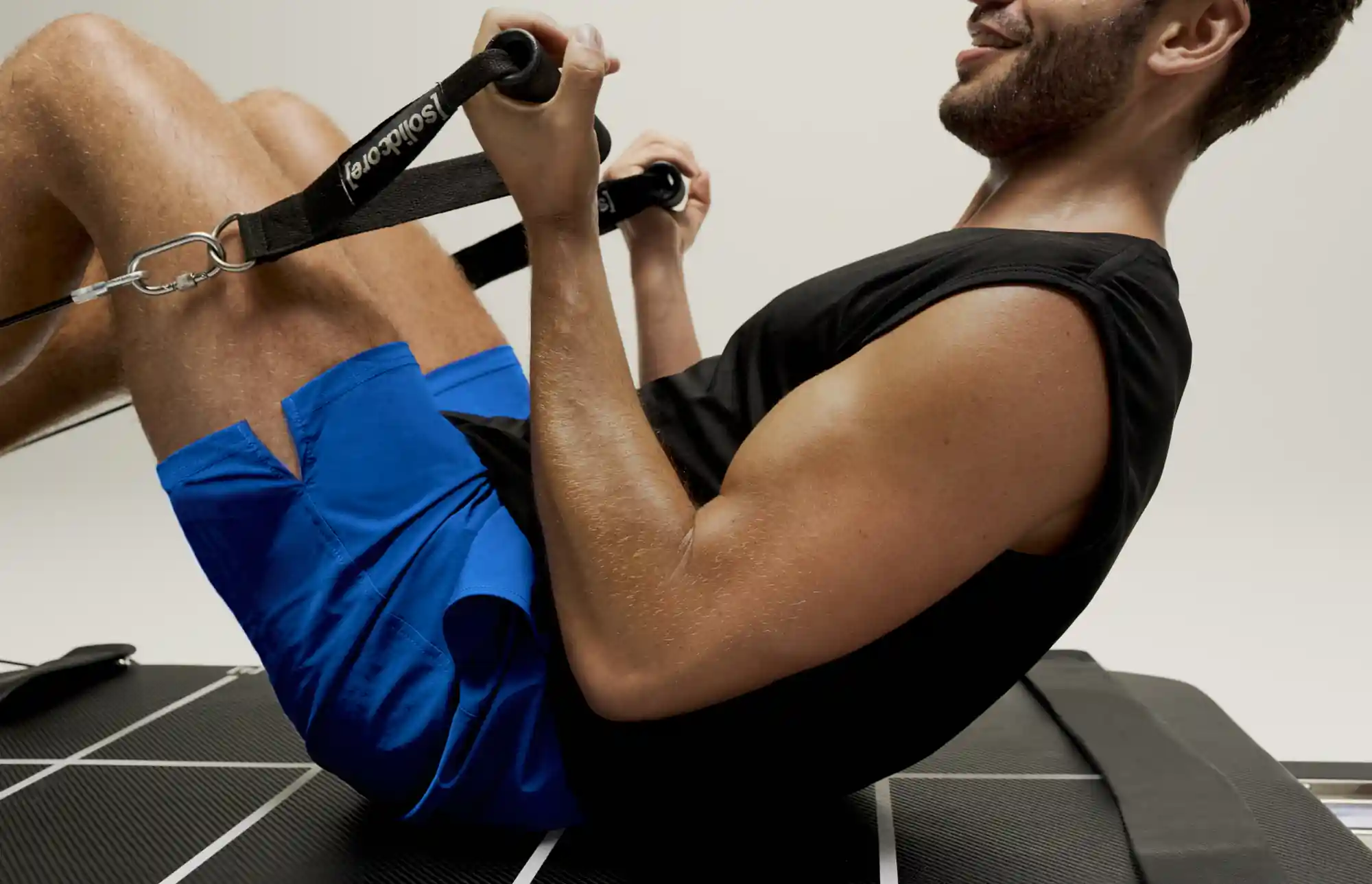

Every full-body [solidcore] class trains core and obliques, plus one lower-body muscle group and one upper-body muscle group set by the monthly muscle focus calendar. Here's every muscle group that comes up, and what each one actually does.
Two muscles do most of the work here. The rectus abdominis, the most surface-level of the core muscles and the one responsible for the visible "six-pack," causes spinal flexion, the forward-rounding motion your torso makes when you crunch or curl. Building strength here supports posture, injury prevention, and balance, and has been linked to a reduction in low back pain.
Underneath it sits the transverse abdominis, the deepest core muscle and the one most responsible for actual spinal stabilization. It draws in the abdominal wall to create proper abdominal pressure and stabilizes the spine during trunk movement. In class, it's the muscle you're switching on every time you tuck your tailbone.
A strong transverse abdominis is one of the more reliable ways to reduce low back pain, and it's also what keeps your lower back from getting fatigued or sore after a long day of standing or walking.
More on building core strength.
The internal obliques rotate the torso and help support the spine and posture through that rotation.
The external obliques handle lateral flexion, the side-bending motion you feel when you reach down toward one hip.
Together, they're responsible for most of the rotational and side-bending strength in your midsection, which is exactly why they get their own dedicated section rather than getting folded into core.
More on your obliques and the exercises that target them, plus what to do if you show up with sore obliques.
Center glutes, or the gluteus maximus, are what extend the hip, pressing your leg behind you and opening the front of the hip joint. This is the muscle holding you upright and propelling you forward in everything from walking to running to jumping.
Outer glutes, the gluteus medius and gluteus minimus, cause hip abduction (moving the leg away from the body's midline) and external rotation. Functionally, they're what stabilize your hips so one side doesn't drop every time you step onto the opposite foot, and they're what let you move side to side and change direction instead of only moving straight ahead.
Hamstrings are a group of three muscles working together: the biceps femoris, semitendinosus, and semimembranosus. They handle knee flexion and hip extension, and they play a major role in running, jumping, and squatting, as well as the deceleration that happens when you slow from a run to a walk or come to a stop.
Inner thighs are a group of five: adductor longus, adductor brevis, adductor magnus, gracilis, and pectineus. They cause hip adduction, drawing the leg back toward the body's midline, and assist with knee and hip stabilization. They're paired with the outer glutes in the leg wrap.
Quadriceps, the muscles on the front of the thigh, handle knee extension and hip flexion. They're active as a secondary muscle in nearly every plank-based and lower-body exercise in class, which is exactly why there isn't a dedicated quad day on the calendar. They're already getting consistent work as a supporting player, and skipping a standalone focus keeps the rest of the lower body from being neglected in comparison.
Back is the primary pull muscle group, made up of three muscles working together. The latissimus dorsi handles shoulder extension and general back stabilization, essentially pulling and holding loads in close to your body. The rhomboids stabilize the shoulder and scapula and pull the shoulder blades together. The trapezius manages scapular movement along with support for the neck and head.
Chest is the primary push muscle group. The pectoralis major drives shoulder flexion and internal rotation, the motion of pushing something away from your body, while the pectoralis minor helps stabilize the scapula underneath it.
Biceps act as a secondary pull muscle. The biceps brachii, made up of two heads (short and long), causes elbow flexion and forearm supination, and assists the back whenever you're pulling.
Triceps act as a secondary push muscle. The triceps brachii, made up of three heads (long, lateral, and medial), extends the elbow and shoulder and assists the chest whenever you're pushing. Biceps and triceps come together with chest or back in the arm wrap.
Shoulders are driven by the deltoids and the rotator cuff. The deltoids handle flexion, extension, abduction, adduction, and rotation of the arm: the anterior deltoid lifts the arm forward, the lateral deltoid lifts it out to the side, and the rear deltoid lifts it behind the body. The rotator cuff, a group of four smaller muscles (supraspinatus, subscapularis, infraspinatus, and teres minor), doesn't move the arm so much as it stabilizes the shoulder joint so the bigger muscles around it have something solid to work from.
Across a month of classes, the rotation covers every one of these groups on both sides of the body. Curious how the sections themselves are put together? Here's how a [solidcore] class is built.
What muscles does a [solidcore] class work?
➜ Every full-body class trains core and obliques, plus one lower-body group (center glutes, outer glutes, hamstrings, inner thighs, or a leg wrap) and one upper-body group (back, chest, biceps, triceps, shoulders, or an arm wrap).
Is [solidcore] a full-body workout?
➜ Yes, across a month rather than within one class. Each class trains core, obliques, and one muscle group each from the upper and lower body; the monthly rotation cycles through all major groups.
Does [solidcore] work your glutes?
➜ Yes. Center glutes (gluteus maximus) and outer glutes (gluteus medius and minimus) each get dedicated focuses on the calendar, and outer glutes also appear in the leg wrap.
Does [solidcore] work your quads?
➜ Yes, as a secondary muscle in nearly every plank-based and lower-body exercise. There's no dedicated quad day, because they're already getting consistent volume as a supporting muscle.
Does [solidcore] work your arms?
➜ Yes. Biceps, triceps, chest, back, and shoulders each get dedicated focuses, plus the arm wrap, which trains three upper-body groups in a single sequence.
Does [solidcore] work your back?
➜ Yes. Back is the primary pull muscle group, covering the latissimus dorsi, rhomboids, and trapezius. It gets dedicated calendar days and also appears in the arm wrap.
What is the deepest core muscle [solidcore] trains?
➜ The transverse abdominis. It draws in the abdominal wall to create abdominal pressure and stabilizes the spine during trunk movement. Tucking your tailbone is how you engage it in class.




 Your Privacy Choices