

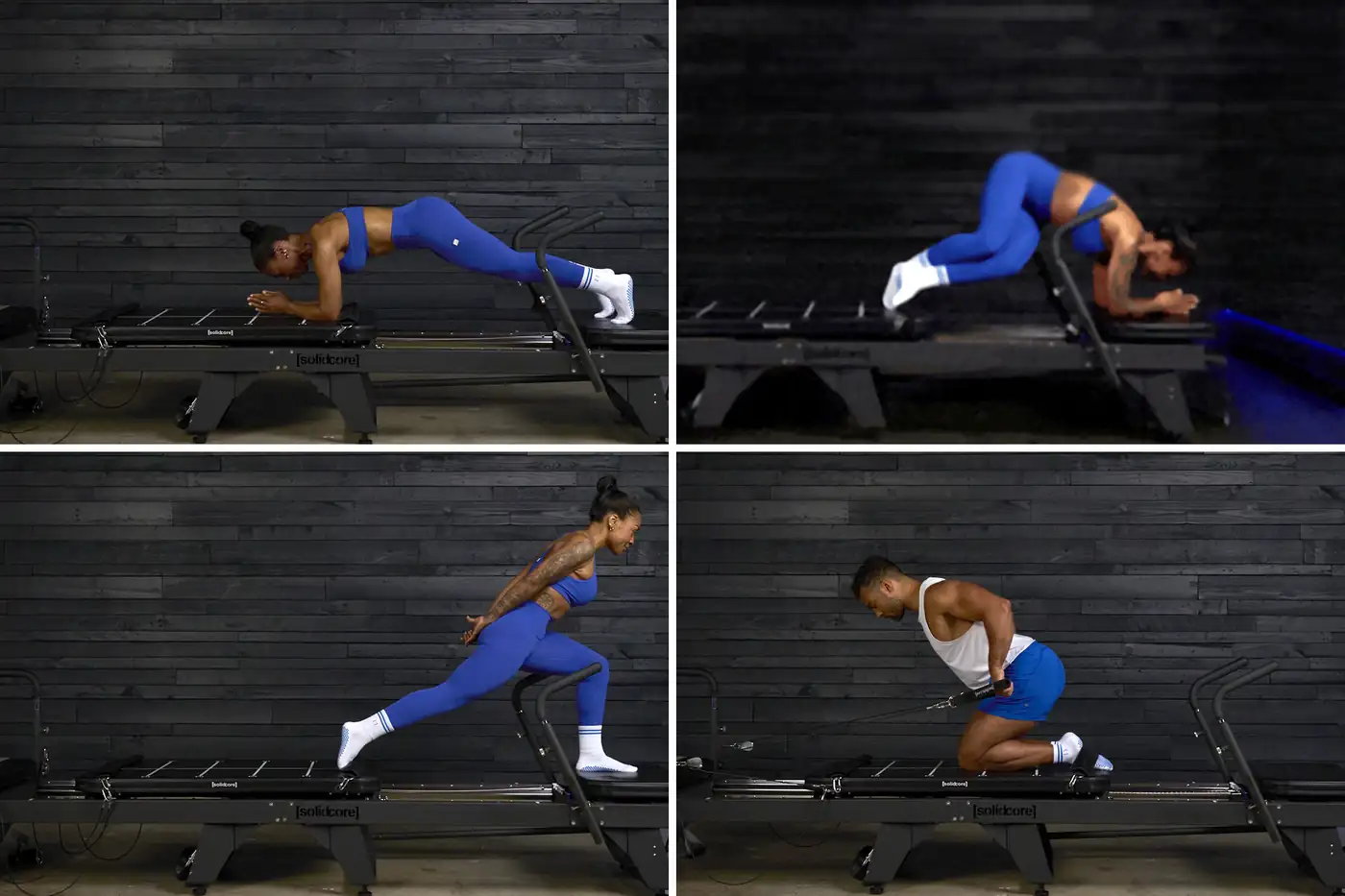

Behind every [solidcore] class is a structure that was engineered on purpose, section by section, muscle by muscle. Here's how a class is actually built, and what each section is doing to your body while it's happening.
The short version: every Signature50 class covers four sections: center core, obliques, one lower-body muscle group, and one upper-body muscle group. Each section works a single muscle group to failure before class moves on. The lower-body and upper-body focus changes every day on a monthly muscle focus calendar, so you can come back day after day without working the same muscle to failure twice.
A Signature50 class always covers four sections: core, obliques, lower body, and upper body. The order they come in changes from class to class, but all four are always there.
Center core is the foundation everything else depends on. You're working on a moving carriage, so a big part of class is building the core stability that keeps you balanced and supported through every other section. Physical therapists describe the core the same way: it is the foundation for upper-body and lower-body movement, and a weak core limits how well your arms and legs can work.
Core sections typically run eight to twelve minutes, long enough to reach second-stage muscle failure: the point where a muscle isn't just tired but has been pushed to its actual limit.
Lower body and upper body are where the day-to-day variety comes in. Rather than hitting every muscle group in the body every time, each class focuses on one lower-body muscle group and one upper-body muscle group, chosen according to the monthly muscle focus calendar.
The muscle focus calendar is the monthly schedule that assigns every day one upper-body and one lower-body muscle group. Each month is built around the push and pull muscles of the upper body and one or two lower-body groups, arranged so a different muscle gets the spotlight each day. It isn't random, and you can see this month's focus any time on the calendar.
That matters for two reasons.
- First, recovery. Mayo Clinic's guidance is to rest a full day between working the same muscle group. Rotating the focus daily builds that rest into the schedule: you can take class several days in a row without asking the same muscle to work to failure again before it's had time to rebuild.
- Second, progression. The muscle groups on the monthly calendar get hit more often over the course of the month, which is what drives progressive overload. That is the principle behind the American College of Sports Medicine's 2026 recommendation that healthy adults train progressively, and research shows that working a muscle group twice a week builds more muscle than working it once. Random one-off hard days don't add up to anything. The calendar does.
The calendar is also built to develop both sides of the body: anterior and posterior, push and pull, front and back. Left unchecked, most people's training (and most of daily life) overdevelops the muscles you can see in a mirror and underdevelops the ones holding everything up from behind. Rotating through both sides deliberately is what produces a body that is strong and balanced, not just strong in the places that are easy to notice.
Walk into most group fitness classes and an "upper body" section might string together one biceps exercise, one back exercise, one triceps exercise, touching a lot of muscles briefly without pushing any single one very far.
[solidcore] does the opposite. Each section is built around agonist supersets: two or more exercises for the same muscle group, programmed back to back with no rest. One muscle group works until it reaches failure, and once it's done, class doesn't come back to it. That's usually two to five exercises in a row, all targeting the same muscle, whether that's back, hamstrings, or triceps.
There's research behind both halves of that design. A 2024 analysis in Sports Medicine found that muscle growth improves as sets end closer to failure. And a 2021 review in the same journal found that supersets roughly halve training time while keeping total work the same, which is how [solidcore] fits true muscle failure into 50 minutes.
The timing reflects how much work each area needs to get there. Core runs eight to twelve minutes. Obliques run four to six minutes per side. Lower body generally takes fifteen to twenty minutes, depending on which muscle group is up that day. Upper body averages eight to ten minutes, though that swings quite a bit by muscle: a shoulder-focused section might be four to five minutes, while an arm wrap can run twelve to sixteen.
Two muscle focuses are unique to [solidcore]: the leg wrap, which combines outer glutes and inner thighs, and the arm wrap, which combines biceps, triceps, and either chest or back.
The leg wrap exists because outer glutes and inner thighs both handle lateral movement and stabilization. Most daily movement happens in the sagittal plane, forward and back, like walking or running. Side-to-side movement lives in the frontal plane and gets far less practice, so those lateral stabilizers tend to be underdeveloped by default. Giving them dedicated time is part of what builds a balanced lower body rather than just a strong one in the directions you already move in.
The arm wrap runs the other way. It combines three upper-body muscle groups in one sequence, which is why it's the longest upper-body section on the calendar.
None of this is arbitrary.
Every class builds stability before it asks for strength. The daily rotation builds specific muscles without shortchanging recovery. The monthly calendar builds enough repeated frequency to drive real progressive overload.
And the science underneath it is the same science any physical therapist or orthopedic specialist would recognize, just applied inside fifty minutes on a reformer.
Want to see exactly what you'll do in each section? Here is every exercise, section by section, from plank crunch to kneeling tricep kickback.
Now, the next time you're in a leg wrap wondering why your inner thigh is shaking right alongside your outer glute, you'll know it's not random. It's the plan.
Ready to feel it for yourself? Book a class and you'll be stronger for it.
What's included in a [solidcore] Signature50?
Every Signature50 covers four components: center core, obliques, one lower-body muscle group, and one upper-body muscle group. The lower and upper groups are set by the monthly muscle focus calendar.
Which part of a [solidcore] class is longest?
Lower body is typically the longest section of class, generally running fifteen to twenty minutes. Core follows at eight to twelve. Section length tracks how long a muscle group takes to reach failure, so the split shifts with the day's focus.
Does every [solidcore] class follow the same order?
No. The sequence varies by class type and by day. Starter50 adds programmed rest between muscle groups and Advanced50 tightens the transitions, but in every full-body class all four sections are covered and each muscle group is trained to failure before class moves on.
What is the [solidcore] muscle focus of the day?
The muscle focus of the day is the one upper-body and one lower-body muscle group assigned to that date on the monthly calendar. Core and obliques are not listed because they appear in every full-body class.
Can you take [solidcore] several days in a row?
Yes. The daily muscle rotation means you are rarely asking the same muscle to work to failure before it has rebuilt. If class is your main workout, four to five classes a week is the recommended range; read more on how often you should take class.




 Your Privacy Choices