

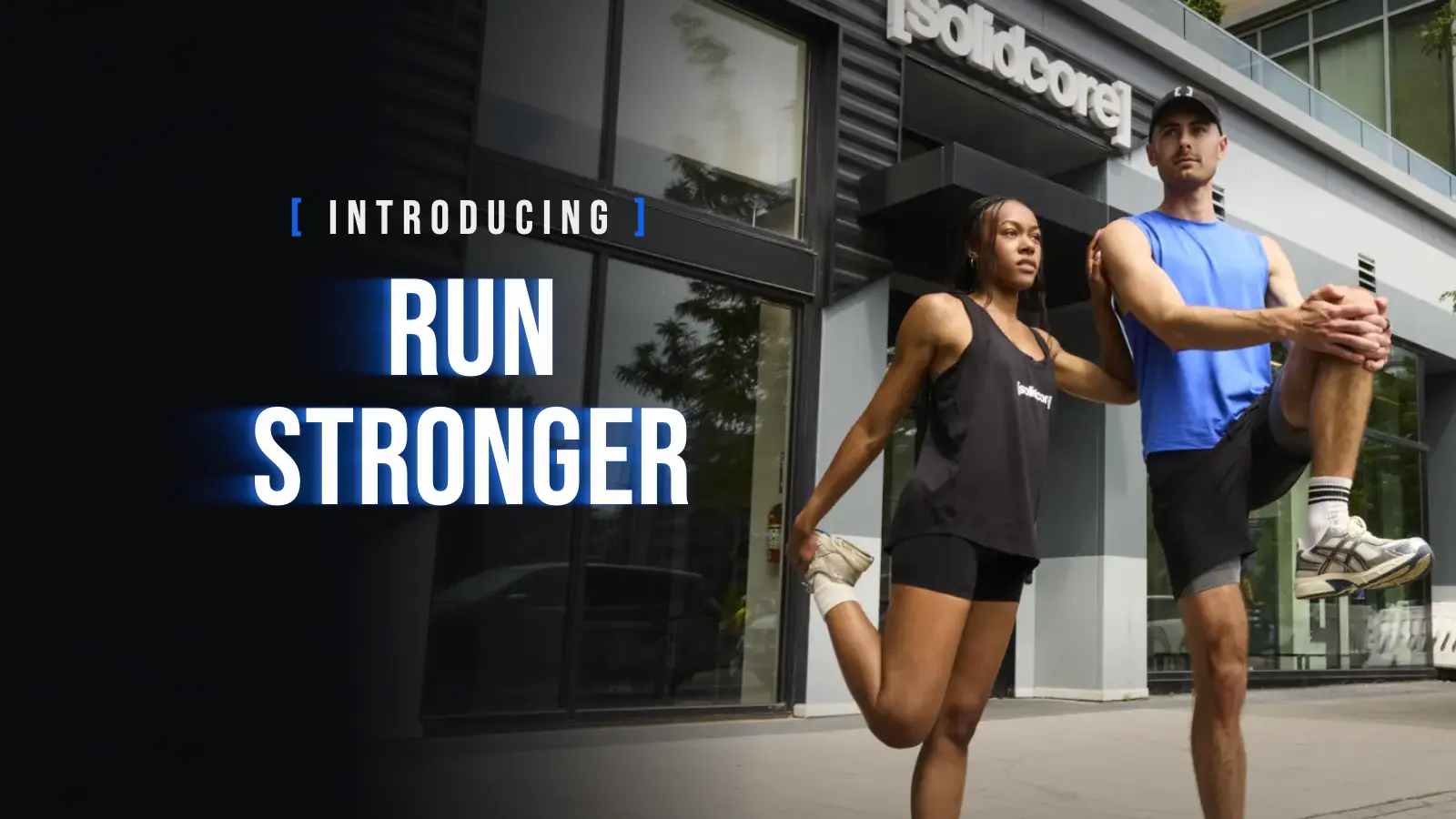

This August, [solidcore] is celebrating the sport of running.
Running is the number one activity our clients pair with [solidcore], more than any other sport or workout. This August, we're showing runners and non-runners alike what [solidcore] is really built for. Welcome to Run Stronger.
All August long, we’re proving that strength training isn't a nice-to-have for runners. It's the foundation.
Exercise of the Week. We are spotlighting a featured exercise chosen specifically for runners, both in themed classes and across our social channels. Knowing why you're doing something changes how hard you work.
August 5: Heavy Glute Kickback and Deadbug
August 15: Bulgarian Split Squat with Rotation and Kneeling Lat Row
August 21: Sumo Inner Thigh Squat and Kneeling Cable Rotation
August 24: S/L Kneeling Hamstring Curl and S/A Kneeling Triceps Kickback
Run Stronger Themed Classes. We're holding dedicated classes built around the exact muscle groups runners need most, on the schedule at every studio August 5, 15, 21, and 24. Look for Signature50: Full Body, Power30: Core + Upper Body, or Power30: Core + Obliques, all under the Run Stronger banner. Every coach is trained to connect every rep directly to your running performance.
Power Your Stride. On Sunday, August 30, we're taking it outside. Power Your Stride brings a [solidcore]-style run club experience to life at select studios nationwide: a Power30 class, then a 30-minute group run led by a local run club partner. It's community, accountability, and a deeper connection to the [solidcore] you already know. Just with a run attached. Celsius is fueling the entire event with products for every participant.
New to [solidcore]? Start here.
Running is repetitive and one-directional. Over time, that creates muscle imbalances, a leading cause of overuse injuries. [solidcore] strengthens the stabilizing muscles runners depend on most: glutes, hamstrings, adductors, and core. Better stability and strength translate directly into fewer injuries and a more resilient stride.
Strong glutes keep your hips level, reducing knee strain. Strong hamstrings improve push-off power and are far less likely to strain mid-stride. A strong core holds your form together during long runs, exactly when fatigue starts to break it down.
There's a reason strength work matters even for a sport as demanding as running. Your slow-twitch muscle fibers are built for sustained effort. Training them improves fatigue resistance, so your form and power hold up over long distances. It also protects against injury: when slow-twitch fibers tire, form breaks down and your body starts overrecruiting fast-twitch fibers that aren't built for endurance.
Running and [solidcore] are both high intensity, but only one is high impact. Running puts repeated stress on your joints with every foot strike. [solidcore] delivers the same intensity without the impact, so you build strength, power, and endurance while giving your joints a break. Together, they make you a stronger runner without piling on extra wear and tear.
Runners tend to think of their sport as a lower-body activity, but every part of your body is working on every run. Here's what's actually driving your stride, and how [solidcore] trains it.
Glutes. Your outer glutes (medius and minimus) stabilize your hips, keeping them level so your knees don't cave. Your center glute (maximus) drives hip extension. That's the power behind every push-off. Strong glutes improve form, boost efficiency, and lower your risk of IT band syndrome and runner's knee.
Hamstrings. They control your leg as it swings forward, decelerating it before each foot strike and protecting your knees from impact. They also power hip extension alongside your glutes. Strengthening them improves speed and power while lowering your risk of strains, one of running's most common injuries.
Core and hip flexors. Your abdominals and hip flexors work together to drive your knees forward and keep your torso stable. Strong abs prevent your trunk from twisting or sagging as fatigue sets in, so the power from your lower body actually translates into forward motion. Strong hip flexors help you lift your knees higher and quicker, improving turnover and speed.
Adductors. Your inner thighs stabilize your hips and control side-to-side movement, keeping your legs tracking efficiently instead of wobbling or collapsing inward. Strengthening them improves push-off power and lateral stability. That pays off on turns and uneven terrain.
Obliques. They control rotation through your torso, keeping you stable as your arms and legs swing. They also protect your lower back as fatigue creeps in.
Lats and triceps. Your back and arms play a bigger role than most runners realize. As your legs generate force, your back and shoulders stabilize your torso, keeping your posture upright instead of collapsing under fatigue. Your arms swing in counter-rotation to your legs, canceling out excess twisting through your trunk so more of your energy moves you forward instead of sideways. A steady, controlled arm swing sets the rhythm of your pace. Train your lats and triceps well and your form holds up longer into the run. That's often what separates a strong finish from a fade.
Whether you're training for your first 5K or your next marathon, or you just want your everyday miles to feel better, [solidcore] gives you the strength and stability running alone can't build. Book a Run Stronger themed class this August, follow along for the weekly featured exercise, and if you're near a participating studio, save the date for Power Your Stride on August 30.
Running got you in the door. [solidcore] is what makes you stronger for it.




 Your Privacy Choices