


You're in a lunge on the reformer at [solidcore]. Your coach counts you into a max tension hold, the carriage stops moving, and nothing about the exercise changes. Then your leg starts shaking.
Sound familiar? New clients usually think those shakes mean they're not "fit" enough, but that's not true. It means you're doing it right.
That shake is the reason the whole class is built the way it is, and it traces back to one idea that shapes everything from our tempo to our machine: time under tension.
Time under tension is the number of seconds your muscle spends actually working during an exercise. More seconds under load means more stimulus for the muscle to adapt, even when the weight stays light.
Every rep has two halves. There's the part where the muscle lengthens under load (the eccentric phase), which could be the carriage sliding away from you, and the part where it shortens and draws the carriage back in (the concentric phase). Time under tension counts both.
At a regular gym, a rep takes maybe a second and a half. Ours take about eight. Four seconds in one direction, four seconds in the other.
That sounds like a small difference until you multiply it out. Ten reps at gym pace is roughly fifteen seconds of real work. Ten of ours is eighty.
Now keep that up for fifty minutes with no programmed rest, which is what a Signature50 is, and you start to understand how a workout with no heavy weights leaves your muscles exhausted by the end.
Here's something nobody mentions about moving fast: physics is quietly doing part of your work.
When you move quickly, your tendons behave like a rubber band, soaking up energy on the way down and handing it back on the way up. It feels great. Your heart rate climbs. But that bounce fires you through the bottom of the movement, which happens to be the exact spot where your muscle has the most to gain.
Our custom-built reformers take that option away. The carriage travels at whatever speed you allow it to, so there's no rebound waiting at the bottom and no way to rush the part you'd rather skip. You have to produce force the whole way through.
This is the least exciting reason we move slowly, but probably the most important one. Your muscle ends up doing the work your momentum used to do.
It's also why your coach keeps cueing full range of motion. Momentum is what lets you shortcut the hardest inches of a movement, so once the bounce is gone, the whole range is available to you.
Heavy lifting builds strength, but it also asks a lot of your joints. A loaded barbell puts compressive force through your spine, knees, and shoulders whether or not your form is perfect that day, and that load goes up as the weight goes up.
Time under tension sidesteps that trade-off. Because the load stays light, the strain on your joints stays low, even while the strain on your muscle climbs. Your knee, your lower back, your shoulder capsule, none of them are working any harder than they would carrying groceries. Your quad, your glute, your deltoid, they're working harder than they have in weeks.
That's the actual mechanism behind "low impact." It's not a marketing softness. It's the direct result of separating how much weight you're moving from how much work your muscle is doing, which a max tension hold does by design. You get the adaptation without a barbell on your spine, without hammering your joints, and without the injury risk that comes with lifting anywhere near your limit. When we say high intensity, low impact, that's the mechanism we're describing.
It's also part of why so many people land here after an injury, a surgery, or just years of a heavier lifting style their body stopped tolerating well. The muscle still gets pushed to its limit. The joint around it doesn't have to be.
New to [solidcore]? Start with a Starter50.
Three things:
Your muscle can sense how much force it's producing and responds by rebuilding to handle more. Take the momentum out and more of that force runs through the muscle instead of around it. This is the same signal a heavy deadlift sends, just delivered through time instead of load.
Holding a contraction slows blood flow to the working muscle, which means the byproducts of that work, things like hydrogen ions and lactate, build up faster than your bloodstream can clear them. That buildup is what you feel as burning, and it's also believed to help trigger the hormonal response that supports muscle growth. It's uncomfortable on purpose.
This is what a max tension hold is really after. Type 1 fibers are the fatigue-resistant ones, responsible for holding a position rather than producing a quick burst. They're stubborn by design, which is why a fast set barely bothers them. A slow one gets there. Hold long enough and they finally hit their limit, break down at a microscopic level, and rebuild stronger than they were.
The second degree of muscle failure (the shaking, the micro-tears, the sudden need for a break) is what that process feels like from the inside. And the payoff turns up in places like the last mile of your run, the last flight of stairs, or the twentieth minute of holding a toddler.
In one study, researchers had participants train at 30 percent of their max, which is genuinely light, and compared two tempos. One leg did reps that took six seconds in each direction, the other did reps that took one second in each direction, matched so that both did the same total work. The slow condition showed more muscle-building activity afterward.
Which is really the whole idea. Slowing down isn't a way to make heavy weight feel heavier. What it does is take a load that has no business being enough and make it enough.
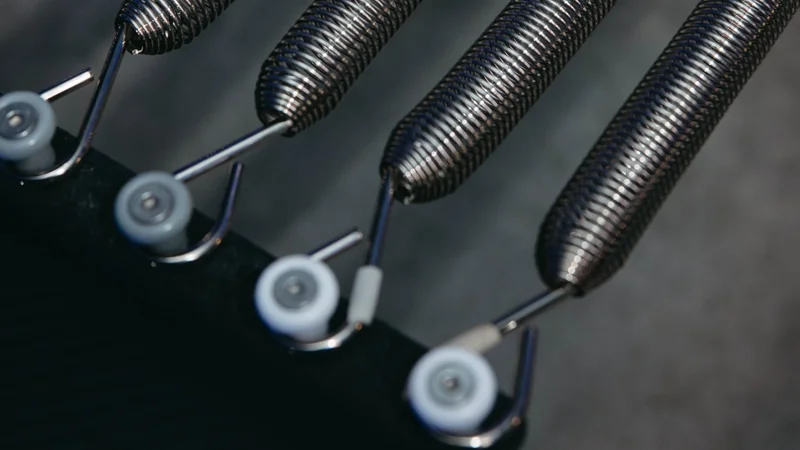
That's what the springs are for. You can set the resistance precisely, and the tempo is what makes that resistance matter.
This is the question we hear most from regulars: if the springs never get heavier, why does class still feel this hard six months in?
Because weight was never the variable doing the work. Time under tension is. As you get stronger, your coach has other ways to keep the muscle working at its limit that have nothing to do with the springs. A hold gets a few seconds longer. A pulse gets added at the bottom of the range, right where you used to bounce out of it. An amplification asks a joint to work through more range than it did last month. None of that shows up as a heavier spring, but all of it is progressive overload.
That's also why the workout scales with you instead of leaving you behind. A brand-new client and someone who's taken class for years can be doing the same exercise on the same spring setting, and both of them can be at their limit, because the limit was always about how long the muscle can hold the line, not how much it's holding.
It's a different definition of progress than most people walk in with. There's no number going up on a plate to track. What goes up instead is how long you can hold the line before it breaks, and that number keeps climbing for years.
Curious how it compares to lifting? Here's how [solidcore] fits alongside weight training.
A variation, meaning a hold or a pulse, buys seconds without adding weight. Max tension parks you at the hardest point in the range and leaves you there.
Amplifications and modifications are the other two levers, and they work from opposite ends toward the same goal. An amplification turns the challenge up, like walking your hands down to the platform bar to ask more of your obliques. A modification turns the support up, giving you a version of the exercise you can hold with good form for the full stretch of time. Either way, you stay in the work, which is the only thing the tension really cares about.
And the transition formula, all those countdowns, exists so the seconds between exercises don't get away from us.
Why do my muscles shake during a [solidcore] class?
Shaking is what fatigue looks like when a muscle is held under tension long enough. It means the slow-twitch fibers a max tension hold is targeting are finally reaching their limit. It's not a sign your form is failing. Here's the full breakdown of the shakes.
Is time under tension better than lifting heavy weights?
They're different tools. Heavy lifting builds maximal strength by adding load. Time under tension builds muscle by adding seconds, with far less compressive force on your joints. Research comparing light and heavy loads finds muscle growth is similar when sets are taken to failure, while heavy loads win for one-rep max strength. Plenty of clients do both, and [solidcore] is a good complement to lifting.
How long should time under tension be?
There's no single magic number per set. Research on rep tempo suggests the total time a muscle works across a session matters more than the length of any one set. At [solidcore], each direction of a rep takes about four seconds and a Signature50 runs 50 minutes with no programmed rest, so your muscles spend most of the workout actually working.
Is time under tension good for beginners?
Yes. The springs set the load, so the same movement scales from your first class to your hundredth. If you're new, start with a Starter50 or Foundation50 class.
So the next time your leg is shaking at second forty in a max tension hold, you'll know exactly what's happening and why we built the whole class around it. It never really gets easier. You just get stronger for it.
Curious what time under tension feels like? Find a class near you and see for yourself.




 Your Privacy Choices